
Torticollis, also called “wry neck,” is a condition where a baby’s head is tilted to one side while the chin turns to the other side. It is usually caused by tightness or imbalance in the neck muscles, especially one muscle on the side of the neck called the sternocleidomastoid (SCM).
Most cases of torticollis are not dangerous, but it is important to treat it early so your baby’s neck, posture, and head shape develop normally.
If you’ve noticed a baby’s head always tilting to one side or chin turning to the other side, or you recently had a difficult birth, or are using a lot of swaddling/sleep positioning, and want to know what this is, if it’s serious, and what you can do at home, keep reading.
What Is Torticollis?
Torticollis means “twisted neck” and describes a head posture where the neck is both tilted and twisted at the same time. In babies, the most common type is congenital muscular torticollis (CMT), which usually appears soon after birth or in the first few months of life.
In simple terms:
- The head tilts toward one shoulder.
- The chin points to the opposite side.
- Sometimes you may feel a small lump or thickened band in the neck muscle on the affected side.
Torticollis can also occur in older children and adults, but in this article, we focused on infants and young children.
What Causes Torticollis in Babies?
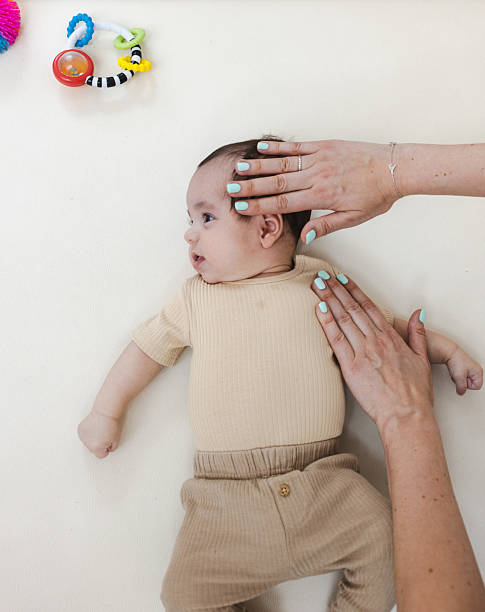
Several things can cause a baby’s neck to stay tilted to one side.
- Congenital muscular torticollis – CMT (from birth)
The neck muscle (SCM) is shorter or tighter on the affected side than on the other side.
It is often linked to the baby’s position in the womb (for example, cramped space, breech position, or being one of twins or triplets).
CMT is sometimes caused by birth trauma, such as a difficult delivery, forceps, vacuum, or tight neck positioning during birth.
Rarely, there can be a small bleed or swelling inside the neck muscle early in life that later turns into a tight band.
2. Positional (postural) torticollis
This happens when a baby often lies or sleeps with the head turned one way, and the neck muscles adapt to that position.
Low tummy time, always facing one side, or tight swaddling can make it worse.
It usually improves quickly with positioning changes and simple exercises.
3. Other possible causes
- Trauma or injury to the neck.
- Infections in the neck, throat, or ears that make the neck stiff and painful.
- Eye muscle problems (ocular torticollis), where the head tilt helps the child see more clearly.
- Neurologic conditions, such as cerebral palsy or other brain or nerve problems.
- Rarely, problems in the bones of the neck or tumors pressing on nerves.
If your baby has sudden neck stiffness, pain, fever, or trouble swallowing, seek medical help urgently, because these can be signs of infection or other serious problems.
Signs to Watch For in Your Baby
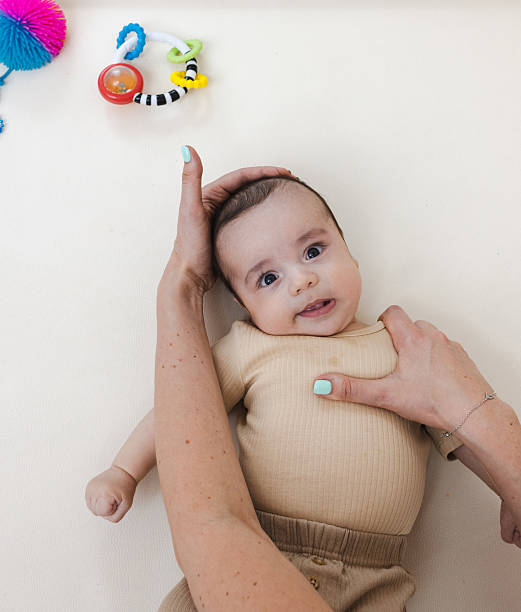
You should see a doctor or physiotherapist if your baby has any of these signs:
- Head always tilted to one side, chin pointing the other way.
- Difficulty turning the head fully to one side, especially when reaching for toys or during feeding.
- A thick band or lump on one side of the neck (this is the tight muscle).
- One side of the face or head is flatter than the other (plagiocephaly).
- One shoulder higher than the other, especially when the head is tilted.
- Delayed neck control or inability to bring the head up during tummy time.
In older children or adults, torticollis can also cause neck pain, spasms, or involuntary twisting of the head and neck, which is called cervical dystonia.
When to See a Doctor or Therapist
Contact a healthcare professional as soon as possible if:
- The head tilt started suddenly, or your baby seems to be in pain when moving the neck.
- There is fever, swelling, or trouble breathing or swallowing.
- Your baby looks very stiff, weak, or has unusual movements in the body or face.
- The head tilt does not improve at all over several weeks, even with gentle stretching and position changes.
Most babies with early‑onset torticollis recover better when treatment is started within the first few weeks to months of life.
How Torticollis Is Diagnosed
Doctors and physiotherapists use a few simple steps to diagnose torticollis:
- History: When the head tilt started, how the baby was born, and how the baby is carried, held, and put to sleep.
- Observation: How the baby holds the head at rest, any flattening of the skull, and whether one shoulder is higher.
- Range of movement: Checking how far the baby can turn the head sideways and tilt it toward each shoulder.
- Feeling the neck muscle: Looking for tightness or a lump in the SCM.
In some cases, they may order:
- Ultrasound of the neck muscle to check for tightness or scarring.
- X‑ray, CT, or MRI if they suspect a problem with the bones of the neck.
- Blood tests or other tests if an infection or other medical condition is suspected.
In low‑resource or high‑volume settings, detailed imaging may not always be available immediately, but a good clinical exam combined with early therapy can still make a big difference for many babies.
What Treatment Can Do

The good news is that many babies with torticollis improve a lot with early treatment, especially physiotherapy.
Treatment cannot “cure” the underlying cause (for example, a structural neck problem), but it can:
- Loosen the tight neck muscle and improve how far the baby can turn the head.
- Improve the baby’s posture and head control.
- Reduce or prevent flattening of the skull (plagiocephaly) and shoulder asymmetry.
- Help the baby reach developmental milestones, such as rolling, sitting, and crawling, more comfortably.
In some babies, especially those with severe or long‑standing torticollis, treatment may include:
- Physiotherapy and stretching.
- Botulinum toxin (Botox‑type) injections to relax the tight muscle temporarily.
- Rarely, surgery to release the tight muscle, if other treatments have not worked.
What Physiotherapy and Home Care Can Do
Physiotherapy for torticollis is usually gentle, safe, and easy to combine with parenting. Here’s what therapy typically involves:
- Gentle stretching of the tight neck muscle, done several times a day in short sessions.
- Active turning exercises: Encouraging the baby to look toward the non‑preferred side during play and feeding.
- Positioning and handling: Holding, feeding, and carrying the baby so the head is encouraged to turn the “hard” way. Varying the side the baby faces in the crib or during playtime.
- Tummy time and play: Supervised tummy time helps strengthen the neck and shoulders and reduces the risk of a flat head. Games and toys placed on the “weak” side help the baby practice turning.
Parents are often taught a short daily home‑exercise programme, such as:
- Gentle stretching while the baby is calm (for example, after a feed or bath).
- Changing the baby’s position several times a day.
- Using small pillows or rolled‑up towels to support the baby’s head and encourage better alignment during sleep and play.
Research shows that babies who get early physiotherapy plus parent education and stretching often improve faster than those who only get general advice alone. [Rodríguez‑Huguet et al., 2023; Kaur, 2020; Keklicek & Uygur, 2018; Song et al., 2021]
Will My Baby Get Better?
For many babies, torticollis improves greatly or even resolves completely within a few weeks to months, especially when treatment starts early.
However, if treatment is delayed or not done regularly, the baby may keep:
- A slight head tilt.
- A flatter head on one side (plagiocephaly).
- Difficulty fully turning the head in one direction.
That is why early stretching, positioning, and physiotherapy are so important.
FAQs About Torticollis
In many babies, torticollis is not dangerous and is simply a tight or unbalanced neck muscle. However, it can become serious if there is an infection, sudden pain, or other signs of illness, so those need urgent medical review.
Some mild cases improve with time and good positioning, but research shows that babies who receive early physiotherapy and stretching recover better and faster than those who do not.
You should consider physiotherapy if the head tilt has been present for more than a few weeks without clear improvement, your baby has trouble turning the head fully to one side, or you notice a lump in the neck or a flat head. Early treatment usually gives the best results.
- Rodríguez‑Huguet, M., Rodríguez‑Almagro, D., Rosety‑Rodríguez, M. Á., Vinolo‑Gil, M. J., Ayala‑Martínez, C., & Góngora‑Rodríguez, J. (2023). Effectiveness of physiotherapy treatment in congenital muscular torticollis: A systematic review. Children, 11(1), 8. https://doi.org/10.3390/children11010008
- Kaur, S. (2020). Congenital torticollis and its physiotherapy management. International Journal of Health Sciences and Research, 10(2), 246–252.
- Gross, P., Chipman, D. E., & Doyle, S. M. (2022). The tilts, twists, and turns of torticollis. Current Opinion in Pediatrics. https://doi.org/10.1097/MOP.0000000000001194
- Keklicek, H., & Uygur, F. (2018). A randomized controlled study on the efficiency of soft tissue mobilization in babies with congenital muscular torticollis. Journal of Back and Musculoskeletal Rehabilitation, 31(2), 315–321. https://doi.org/10.3233/BMR-169746
- Song, S., Hwang, W., & Lee, S. (2021). Effect of physical therapy intervention on thickness and ratio of the sternocleidomastoid muscle and head rotation angle in infants with congenital muscular torticollis: A randomized clinical trial. Medicine, 100(30), e26998. https://doi.org/10.1097/MD.0000000000026998
- Durguti, Z., Murtezani, A., Spahiu, L., Durguti, T., & Gara, E. (2019). Management of infants with congenital muscular torticollis. Journal of Pediatric Neurology, 17(3), 138–142. https://doi.org/10.1055/s-0038-1660829
- Chen, M. M., Chang, H. C., Hsieh, C. F., Yen, M. F., & Chen, T. H. (2005). Predictive model for congenital muscular torticollis: Analysis of 1,021 infants with sonography. Archives of Physical Medicine and Rehabilitation, 86(11), 2199–2203.
No responses yet